
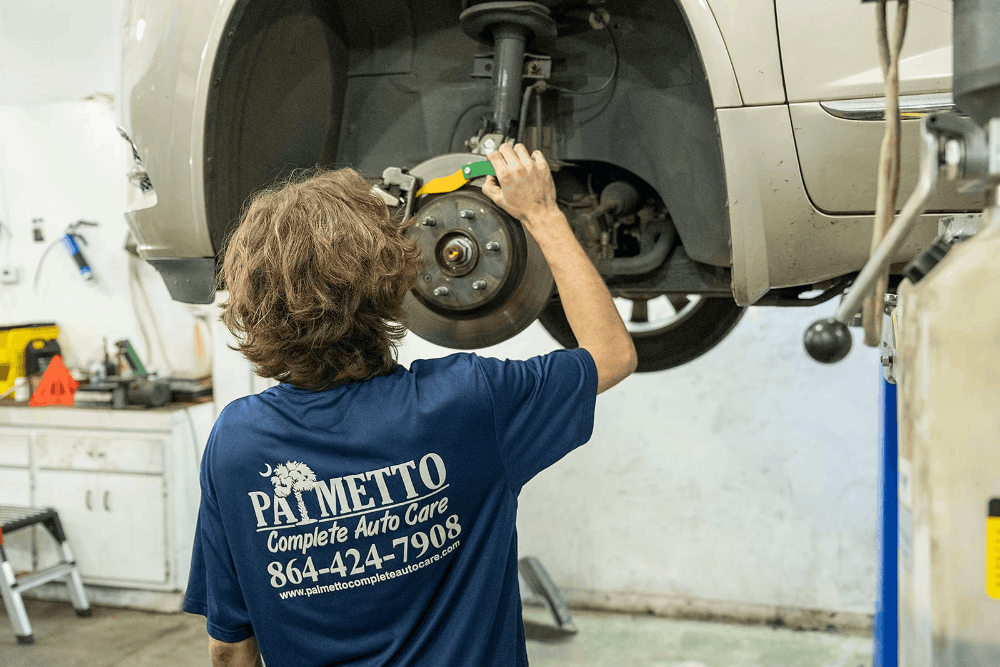
Brake pedal vibration when stopping almost always traces back to a brake rotor surface that isn’t perfectly even, though sticking calipers and worn suspension parts can cause it too. Palmetto Complete Auto Care put this guide together for Piedmont, SC drivers who feel a shake and want to understand it. Below, you’ll find what’s happening behind the pedal, the common causes, and how to tell braking problems from other vibrations.
Brake Pedal Vibration When Stopping: The Short Answer
Your pedal is a messenger. When it pulses, something in or around the braking system is changing how your vehicle slows down. The usual suspects:
- Rotor thickness variation: Thicker and thinner spots make the pads grip unevenly.
- Uneven pad deposits: Friction material collects on the rotor in patches.
- A sticking caliper: A caliper that won’t release can overheat the rotor.
- Worn suspension or steering parts: Loose components let the wheel shake under braking.
What’s Really Happening Under Your Foot When Brakes Pulse
A lot happens in the split second after you press the pedal:
- Hydraulic pressure builds in the brake lines.
- The calipers squeeze the pads against the spinning rotors.
- On an uneven rotor, the grip rises and falls with every wheel turn, and you feel it as a pulse in the pedal.
The differences are tiny. A variation of about a thousandth of an inch, thinner than a sheet of paper, can be enough for your foot to notice. The pulse also speeds up as your vehicle speeds up, and it often worsens as the brakes heat up from extended braking.
You’ve probably heard the phrase “warped brake rotors.” It describes the feeling well, but the cause is often uneven wear or patchy deposits, not a rotor bent like a potato chip.
Four Common Causes of a Shaking Brake Pedal
Rotor Thickness Variation
Uneven wear often starts with a tiny wobble as the rotor spins, from rust on the hub face or uneven wheel mounting, so the pads contact one area more than the rest. Uneven rotor wear like this is a leading source of brake pedal pulsation. It’s also why a pulse can return after a brake job if the root cause remains.
Uneven Brake Pad Deposits
Pads leave a thin layer of friction material on the rotor as they work. When heat builds unevenly, that layer can collect in patches that grip differently than bare metal, which feels like a pulse.
Sticking or Dragging Calipers
Calipers should release the moment you lift your foot. One that hangs up keeps a pad in light contact, which builds heat and can wear a rotor unevenly. Pulling to one side or a hot smell after driving call for a professional look.
Worn Suspension and Steering Parts
Brakes often get blamed for shaking that starts in the parts holding the wheel in place. Worn ball joints, control arm bushings, tie rod ends, or wheel bearings can let a wheel move under braking forces. The fix may fall under suspension repair instead of rotor work.
Pedal Pulse or Steering Wheel Shake? Reading the Clues
Where the vibration shows up tells you a lot:
| What You Feel | Where It Often Points |
|---|---|
| Pedal pulses on most stops | Uneven rotor surfaces or pad deposits |
| Steering wheel shakes when braking | Front rotors or worn front suspension parts |
| Vibration in the seat or floor when braking | Often the rear brakes, though front brakes can be felt through the body |
| Shaking while cruising, even without braking | Tire balance, wheel condition, or suspension wear |
| Vehicle pulls to one side when braking | A sticking caliper, uneven brake force, or a tire, alignment, or steering issue |
Some vehicles, especially trucks, have rear drum brakes, and an out-of-round drum can cause a pulse too. Brake vibration at high speeds usually feels stronger because the rotor spins faster, so a steering wheel that shakes when you brake on the interstate stands out.
Feeling one of these? Bring your vehicle to Palmetto Complete Auto Care at 1802 SC-86, Piedmont, SC 29673, or call 864-424-7908, and our technicians will track down the source.
Why Damp, Cool Mornings Around Piedmont, SC Can Change How Your Brakes Feel
Humid air and cool mornings in the Upstate can change what you feel at the pedal:
- Overnight surface rust: Damp air can leave a thin film of rust on rotors. It can feel rough on the first few stops and usually wipes off quickly.
- A pulse that lingers: If the shake sticks around after the brakes warm up, moisture isn’t the whole story, and it’s time for an inspection.
- ABS feedback: On slick roads or during a hard stop, a quick pedal pulse can be your ABS doing its job. A pulse on normal, dry stops is different and worth an inspection.
Greenville to Anderson: Where Highway Braking Exposes the Problem
If you drive the I-85 corridor between Greenville and Anderson, you brake from highway speed often:
- Exit ramps and merging traffic: Frequent hard stops are where a pulsing rotor shows itself first.
- Game-day drives and holiday visits: More miles mean more heavy braking.
Red Flags: When Drivers in Piedmont, SC, Should Stop and Call a Technician
Most pulsation is a warning, not an emergency. These symptoms mean it’s time to stop driving and get your vehicle inspected:
- The pedal sinks toward the floor or feels spongy
- Grinding or metal-on-metal sounds when you brake
- A burning smell after driving
- The vehicle pulls hard to one side
- The brake warning light stays on
What a Thorough Brake Inspection Looks Like
A thorough brake inspection usually covers:
- Road test: The technician feels the symptom and notes when it happens.
- Wheels off: Rotor surfaces and pad wear patterns get a close look.
- Measurements: Rotor thickness is compared against specifications.
- Surrounding parts: Calipers, hoses, suspension, steering, and wheel bearings are checked.
When the cause isn’t obvious, further diagnostics separate brake problems from other vibration sources.
Why Piedmont, Powdersville, and Anderson Drivers Choose Palmetto Complete Auto Care
Our mission is simple: we treat each vehicle like it belongs to our mothers and look at every auto repair through your eyes.
- Honest Recommendations: We explain what we find and why, so you can decide with confidence.
- Photos You Can See: Digital Vehicle Inspections let us show you photos of what our technicians have already observed.
- Backed Work: We offer a 36-month/36,000-mile warranty on our repairs.
- Convenience: Loaner vehicles and shuttle service keep your week moving.
- Tough Problems: Many drivers come to us after other shops couldn’t pin down the cause.
The Takeaway: Don’t Ignore Brake Pedal Pulsation
Brake pedal vibration when stopping is your vehicle asking for attention.
- Most common cause: An uneven rotor surface or patchy deposits.
- Other possibilities: Calipers and suspension parts can be behind it too.
- Next step: Once the real source is confirmed, brake repair decisions get easier. Before holiday travel, a professional inspection beats guessing.
FAQs About Brake Pedal Vibration When Stopping
Where can I get vibrating brakes diagnosed near Piedmont, SC?
You can bring your vehicle to Palmetto Complete Auto Care at 1802 SC-86 in Piedmont, SC, where technicians inspect the rotors, pads, calipers, and suspension to find the source of the vibration. Drivers from Greenville, Anderson, and Powdersville can reach us off I-85 at Exit 35.
Why does my brake pedal vibrate when I slow down?
Your brake pedal vibrates when the pads grip a rotor surface that isn’t perfectly even, most often from thickness variation or uneven pad deposits, so the pressure rises and falls with each wheel rotation. Sticking calipers and worn suspension parts can cause similar symptoms.
Can uneven brake rotors cause steering wheel vibration?
Yes, uneven front brake rotors commonly cause steering wheel vibration during braking, because the pulsing grip at the front wheels travels through the steering and suspension to your hands, especially from highway speeds. Worn suspension or steering parts can cause the same shake.
Is it safe to drive when my brakes shake?
Mild shaking usually isn’t a sign of sudden brake failure, but it is a warning sign, so limit driving and get your brakes inspected soon. Stop driving if the pedal sinks, you hear grinding, or the vehicle pulls hard. Bring your vehicle to Palmetto Complete Auto Care for a brake inspection before long trips.
Do vibrating brakes always mean I need new rotors?
No, vibrating brakes don’t always mean new rotors, because sticking calipers, uneven pad deposits, or worn suspension parts can cause similar shaking. A technician needs to inspect the system to confirm the real cause.
Schedule Your Brake Pedal Vibration When Stopping Inspection in Piedmont, SC Today
Ready to find out what’s behind your brake pedal vibration when stopping? Schedule your brake inspection with Palmetto Complete Auto Care at 1802 SC-86, Piedmont, SC 29673, or call 864-424-7908. We welcome drivers from Greenville, Anderson, and Powdersville, SC, and we’d love to check your vehicle before holiday travel.
